 AED 150
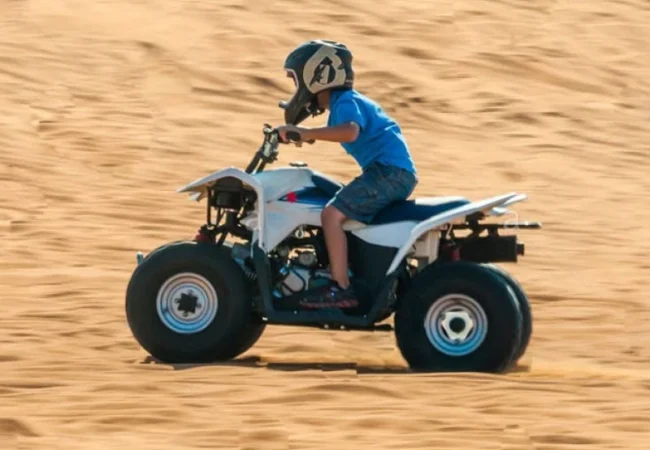
Yamaha 90cc — kids
- Ages 9–12
- Supervised
- Own track
Its own marked loop, well away from the open dunes, with the throttle capped low and a guardian standing there the whole time. Nine-year-olds get real speed without real risk.
Book this quad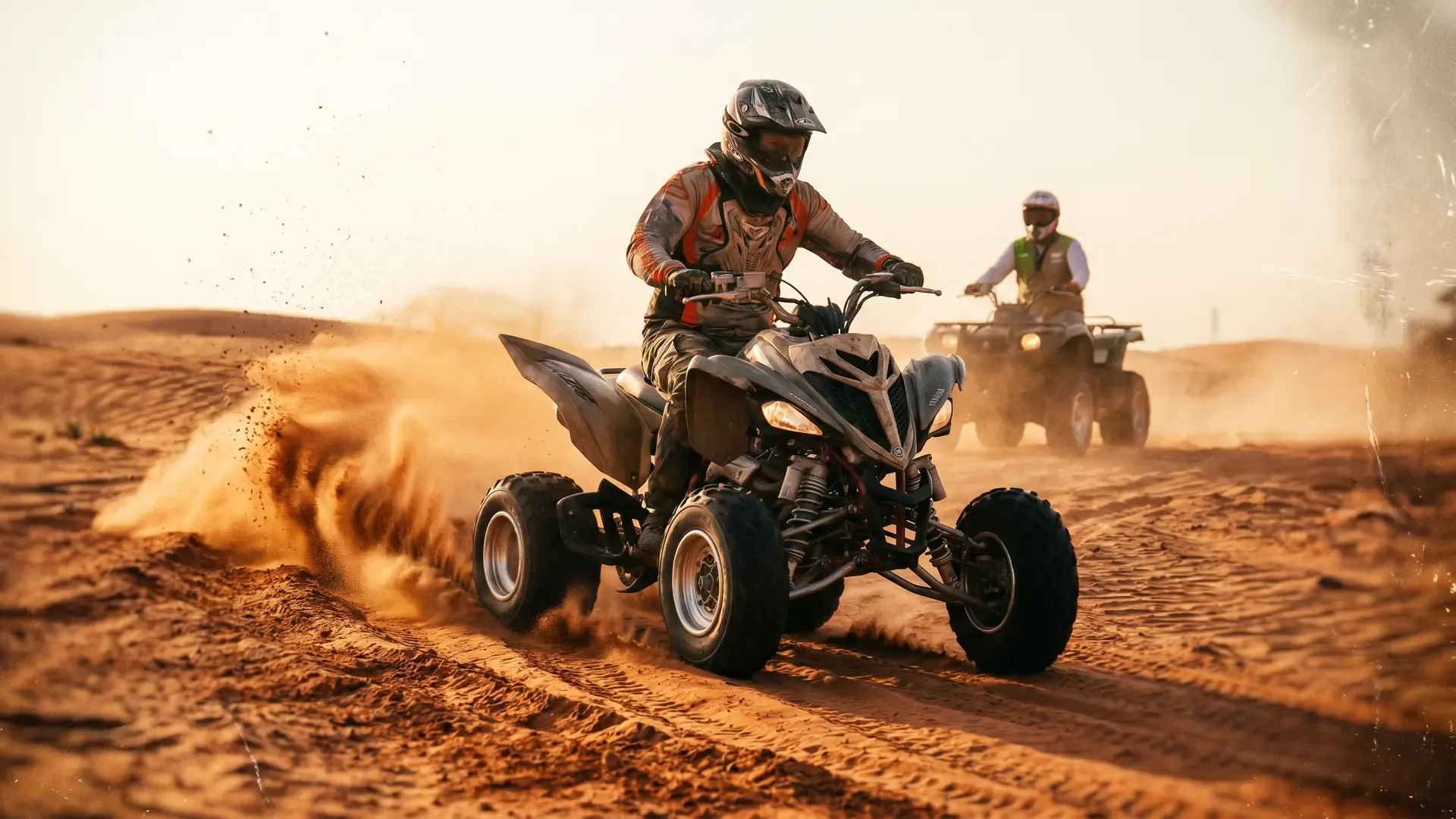
Forget being a passenger. You swing a leg over a Yamaha, your thumb finds the throttle, and the machine goes exactly where your weight tells it to. A lead guide rides the line ahead so you always know where the next drop or climb is coming from. Eight machines sit at the base, built for everyone from a nine-year-old on the supervised 90cc to a rider who wants the 700cc Raptor and nothing slower.
Every session launches from Al Lahbab, the red-sand bowl about 45 minutes southeast of Downtown. Adults step up from AED 200 on the Yamaha 220cc, and the range tops out at AED 795 on the Raptor 700cc, though most riders end up on the 400cc at AED 250 because it climbs without a fight. Nine to twelve-year-olds get their own supervised 90cc loop for AED 150. Whichever machine you pick, the fee covers a helmet, cold water, a hands-on controls briefing and a guide riding point who paces the group to the slowest rider, not the fastest.
Every price below buys one seat on one machine, since that is how a quad works. Only the 400cc double breaks the rule, carrying two people for a single fee. Whichever bike you land on, a quick WhatsApp message locks the details before any money moves.
| Machine | Who it is for | From |
|---|---|---|
| Yamaha 90cc | Children 9 to 12, supervised track, guardian present. | AED 150 |
| Yamaha 220cc | First adult quad. Forgiving throttle, easy to place on a slope. | AED 200 |
| Yamaha 400cc | The one most people end up on. Enough power to climb without drama. | AED 250 |
| Yamaha 400cc double | Two-up seat, one fee. For a pair who do not both want to ride. | AED 350 |
| Yamaha 400cc turbo | Same frame, more shove out of a bowl. | AED 350 |
| Yamaha Grizzly 450cc | Heavier utility frame. Better over rough ground and longer routes. | AED 450 |
| Sports quad 625cc | Lighter and sharper. For riders who already ride. | AED 700 |
| Yamaha Raptor 700cc | Top of the range. Screened before handover. | AED 795 |
Ignore the cc numbers for a second. What matters is whether your hands already know a throttle, because the right match is a bike you ride, not one you wrestle for an hour.
AED 150Its own marked loop, well away from the open dunes, with the throttle capped low and a guardian standing there the whole time. Nine-year-olds get real speed without real risk.
Book this quad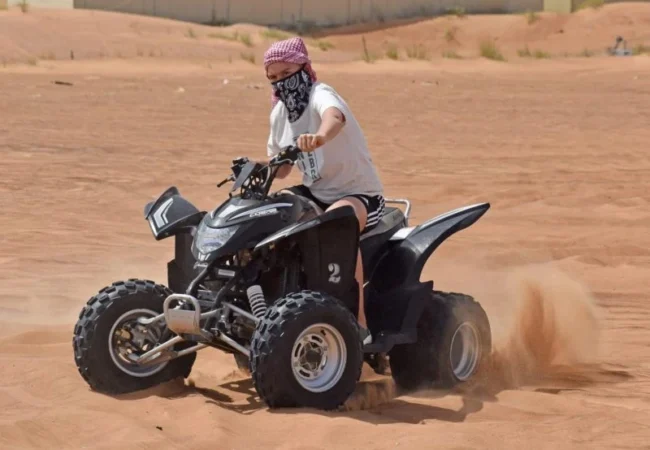 AED 200
Book this if a throttle is new to you. Everything happens slowly enough to think through, and the bike is light enough that a bad line is a quick correction, not a fight.
Book this quad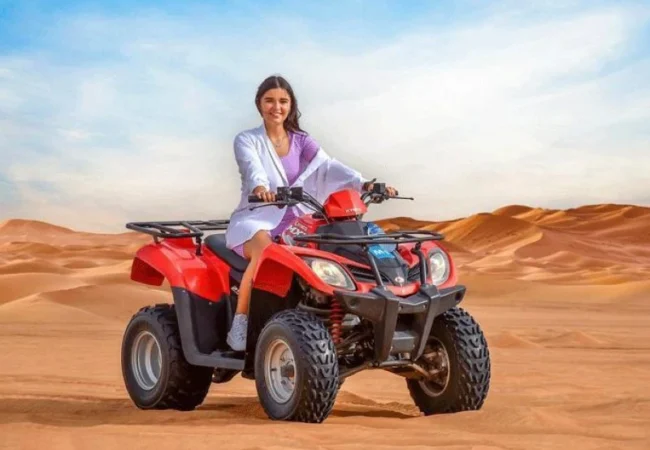 AED 250
Where the guides quietly steer most first-timers, without ever saying so. There is enough pull to carry you up a soft face even when your form is not quite there yet.
Book this quad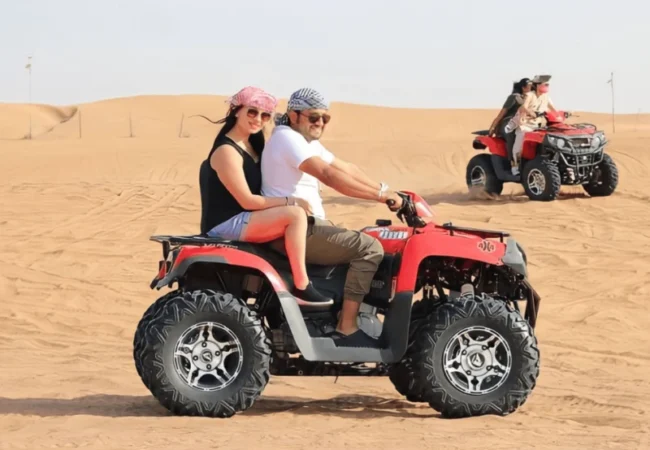 AED 350
One machine, two seats, a single bill. Fits the pair where one person wants the dunes and the other wants the view without touching a throttle.
Book this quadAED 350Same chassis as the standard 400, so your hands already know where everything is. The difference shows up the second you crack the throttle open on a straight run.
Book this quad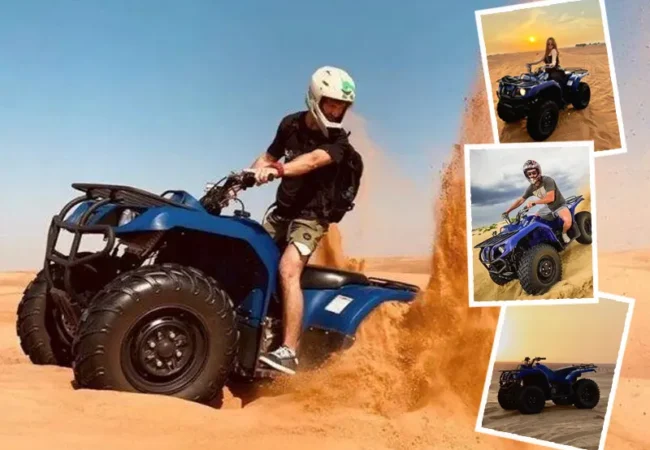 AED 450
Lower, heavier and built for grinding through rutted, broken sand rather than sprinting a smooth face. If your booking runs long, this is the frame that stays comfortable the whole way.
Book this quad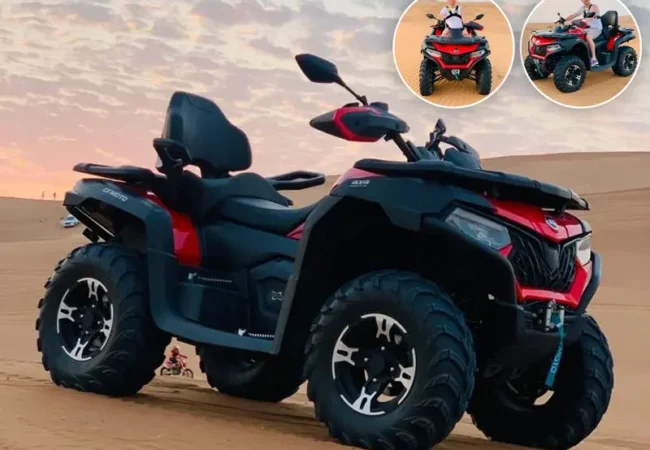 AED 700
Turns in fast and punishes a lazy stance immediately, so you stay up on the pegs through every rut. Riders with real hours on a quad get the most out of this one.
Book this quad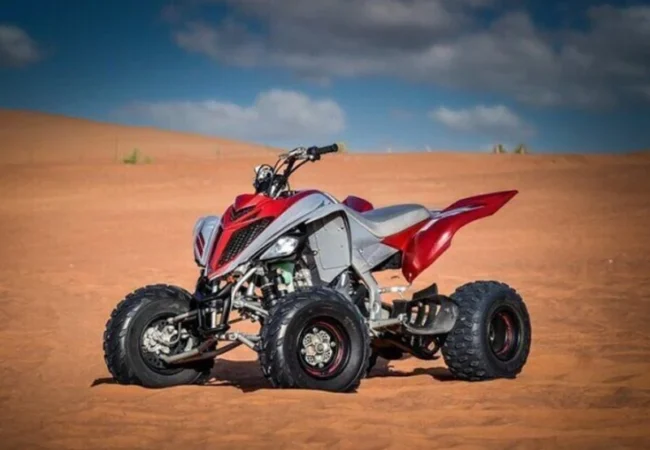 AED 795
Nothing else in the fleet pulls like this. Before the keys change hands there is a short, honest chat about what you have actually ridden, because the Raptor punishes guesswork fast.
Book this quadBolt a Land Cruiser run or a camp dinner onto your quad time, or take both together. This is usually what turns a single hour on a machine into the part of the trip people keep talking about.
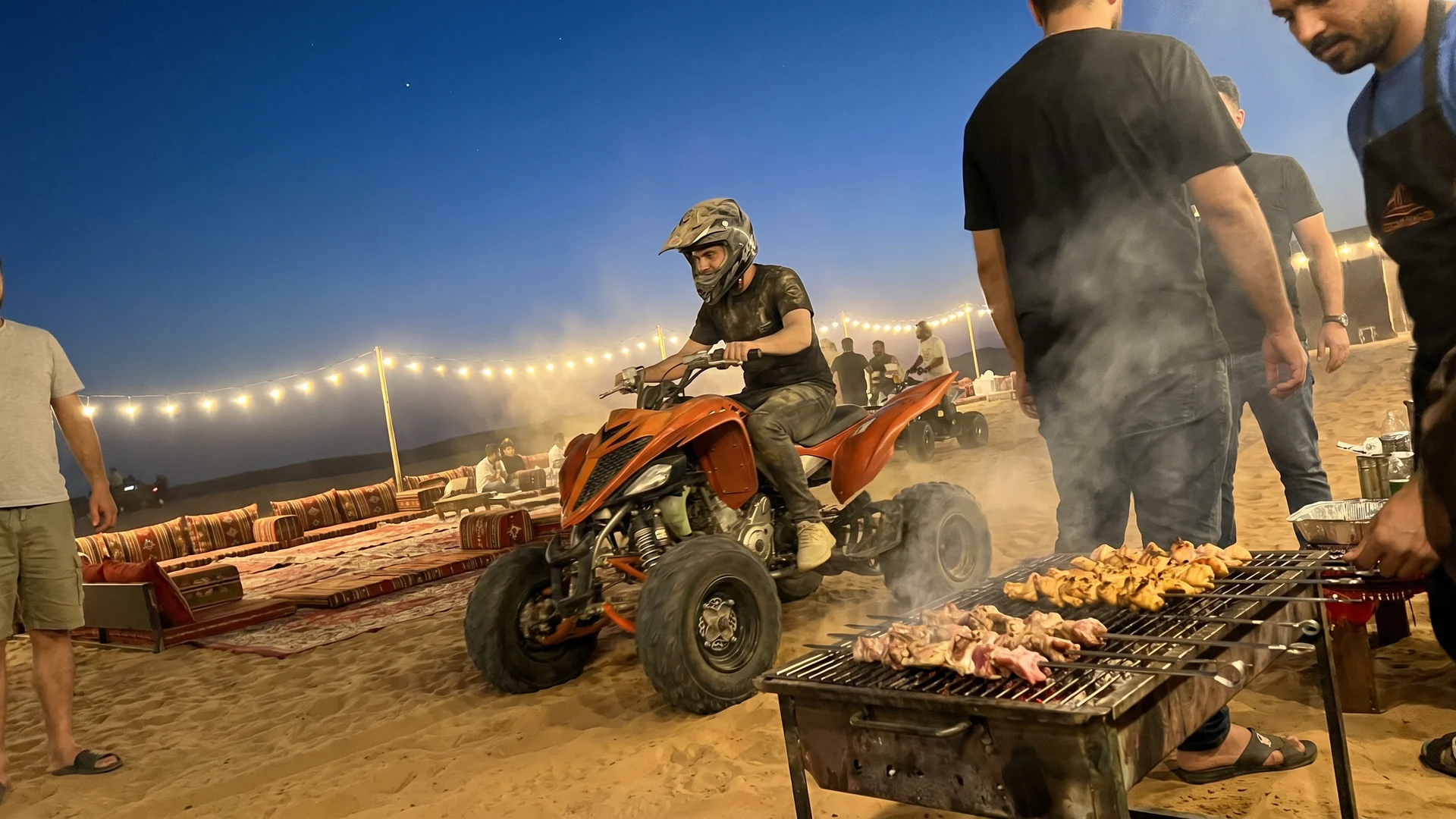 AED 375
A Land Cruiser throws you around the bowls first, then you climb onto your own quad, then the sky goes orange while dinner cooks at the camp. Of everything sold here, this leaves with the most bookings.
Book this combo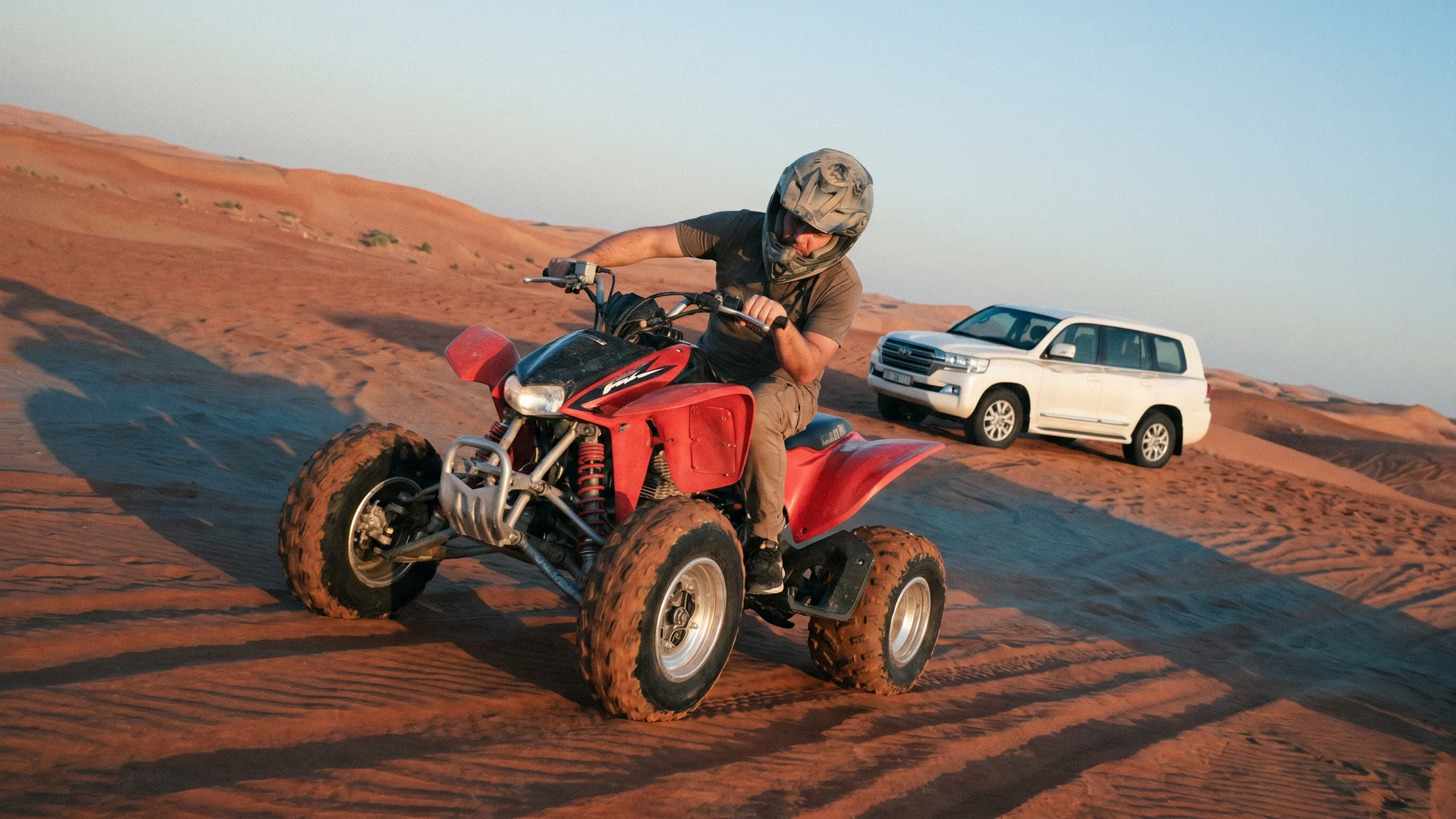 AED 290
Overnight, the sand sets firm, so climbs are easier and the dunes are quieter. You are dropped back in town with most of the day still unspent.
Book this combo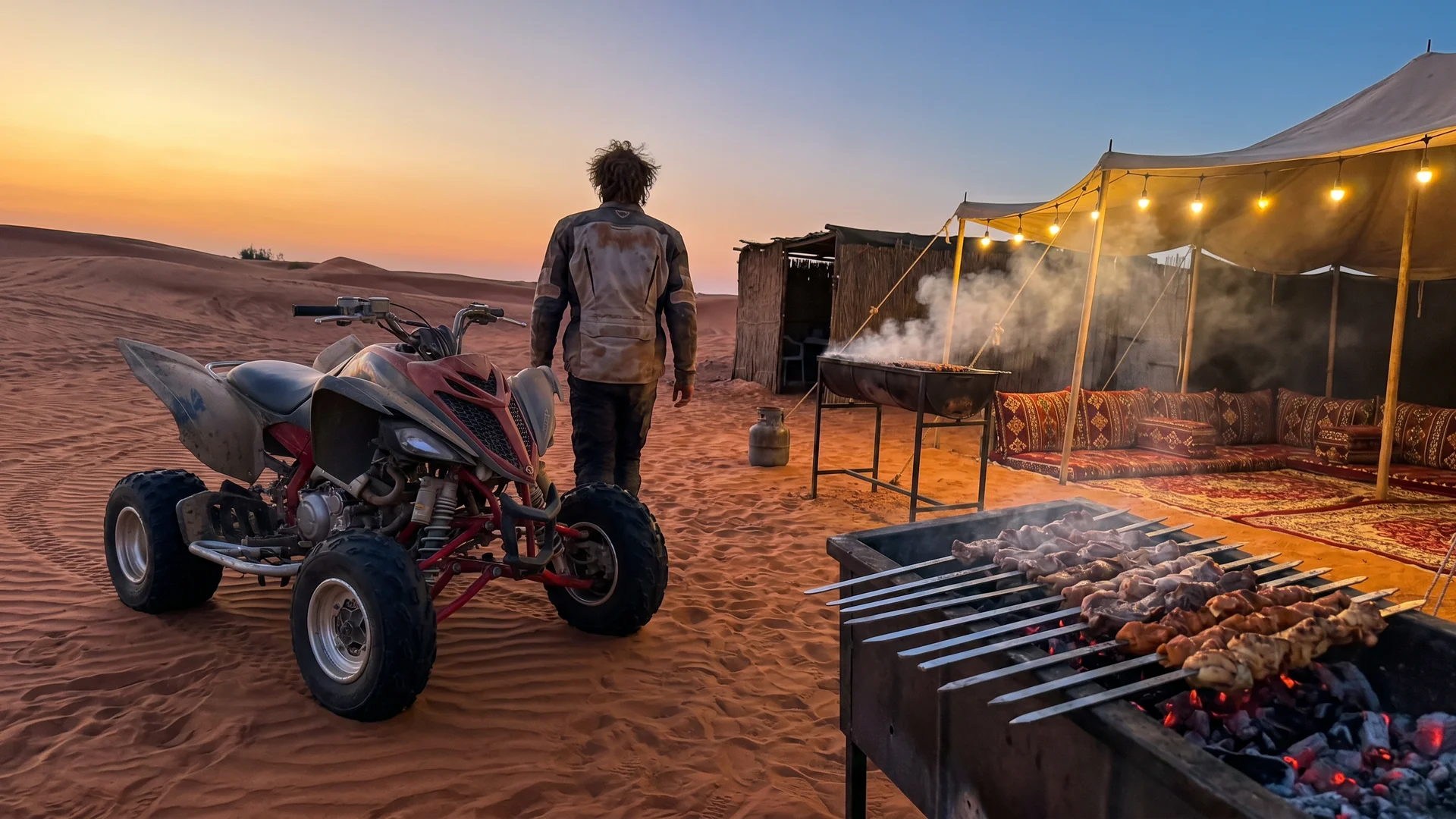 AED 700–1,300
No 4x4 leg here, just your quad session running straight into dinner at the camp. The number you end up paying tracks the machine you chose, not anything different about the food.
Book this combo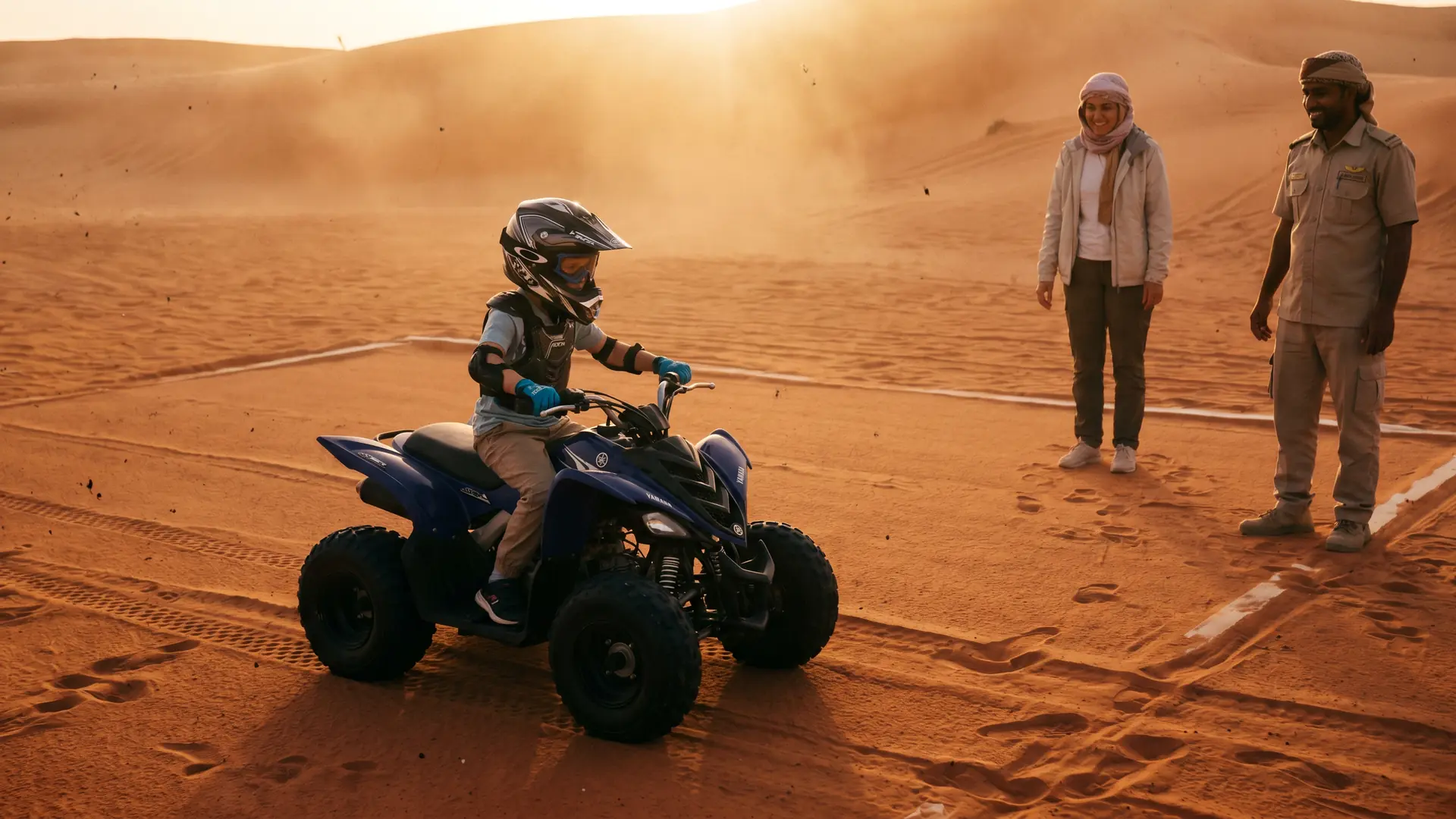 AED 150
Kids loop the 90cc track a few meters from where the adults head out on a bigger machine. Same base, same hour, and nobody is stuck waiting in a parked car.
Book a family sessionSteering wheels don't count here. We mean a motorbike, a jet ski, a dirt bike, anything at all where your hand governs how fast you go.
Most bookings here are mixed groups, so this question comes up more often than not.
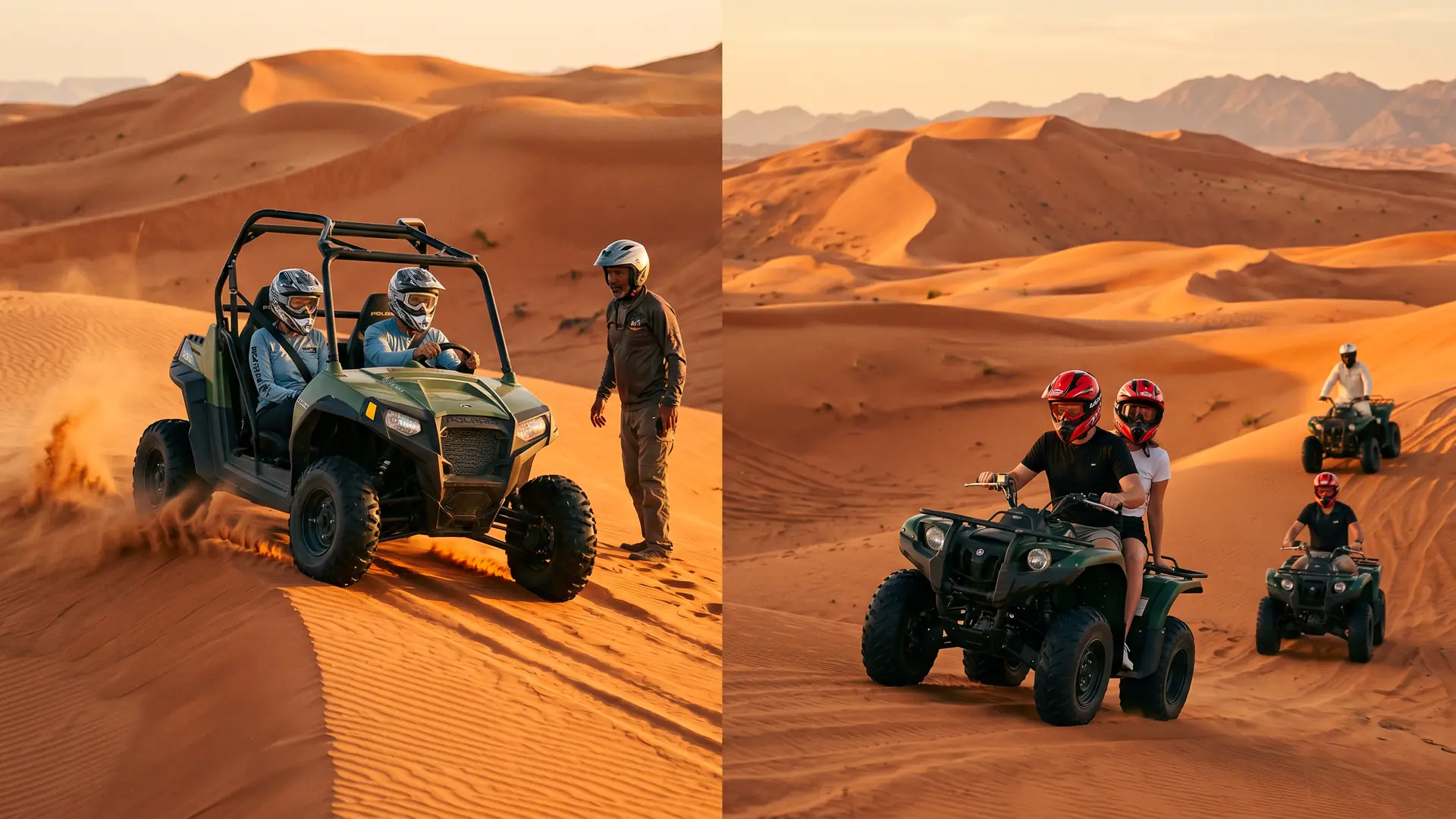
Same red sand, a completely different feel. You get a steering wheel, a harness holding you in place rather than your own balance, and space for company. Plenty of quad bookings turn into a buggy booking too, on the same day.
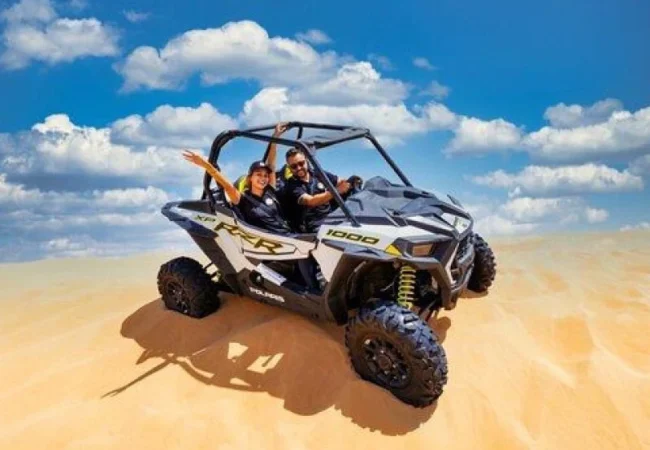
The easiest buggy to jump into cold. Steering stays predictable even when your line isn't.
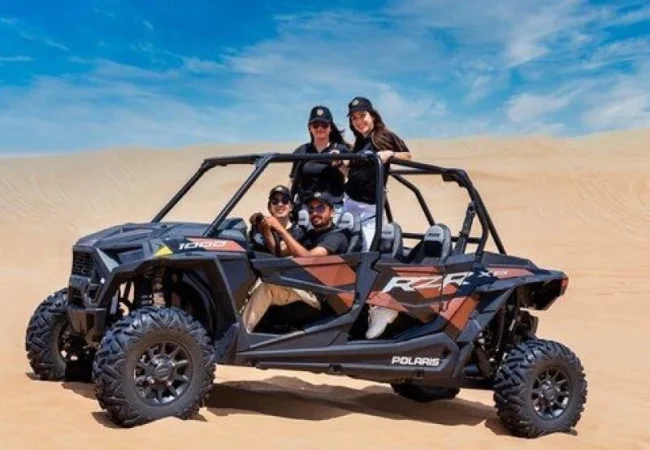
One person steers, the other three just hold on for the ride. Nothing else here divides down to a cheaper rate per person.
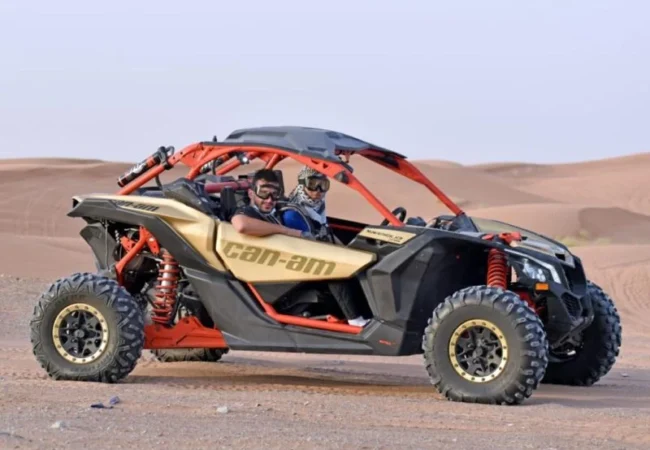
Sits wider and the suspension travels further, so washboard sand barely registers through the seat.
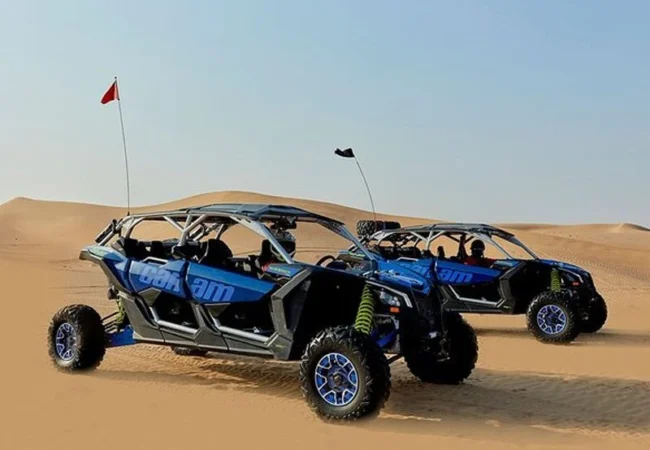
200 horsepower and four seats. Nothing here gets a full group over a ridge line faster.
This is the only booking on the site that starts with a question rather than a price. Sand exposes bad habits on two wheels far quicker than it does on four, and a KTM won't hold you up the way a quad will.
AED 850 buys the hour, AED 1,250 buys two. Come with actual off-road time on a bike already, not just an interest in it.
A no on the dirt bike doesn't rule out speed altogether. Book the Raptor 700cc and you keep most of that pace, only balanced on a quad frame rather than a two-wheeler.
From AED 225. Worth a glance even for quad riders, since it's rare to find a group where absolutely everyone wants to hold the throttle instead of just enjoying the view.
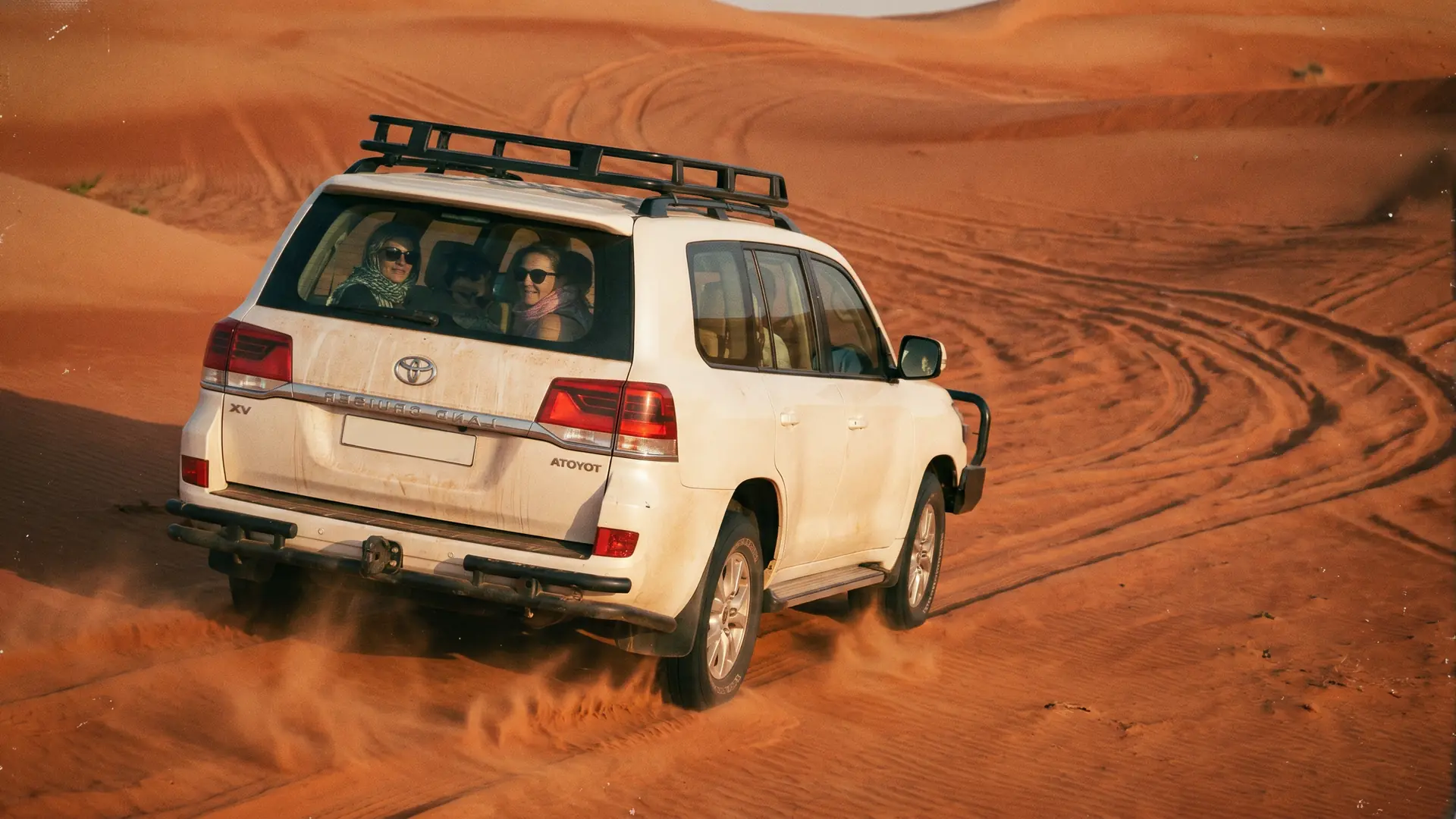
Early collection, firmer cooler sand, and you're back in the city in time for lunch.
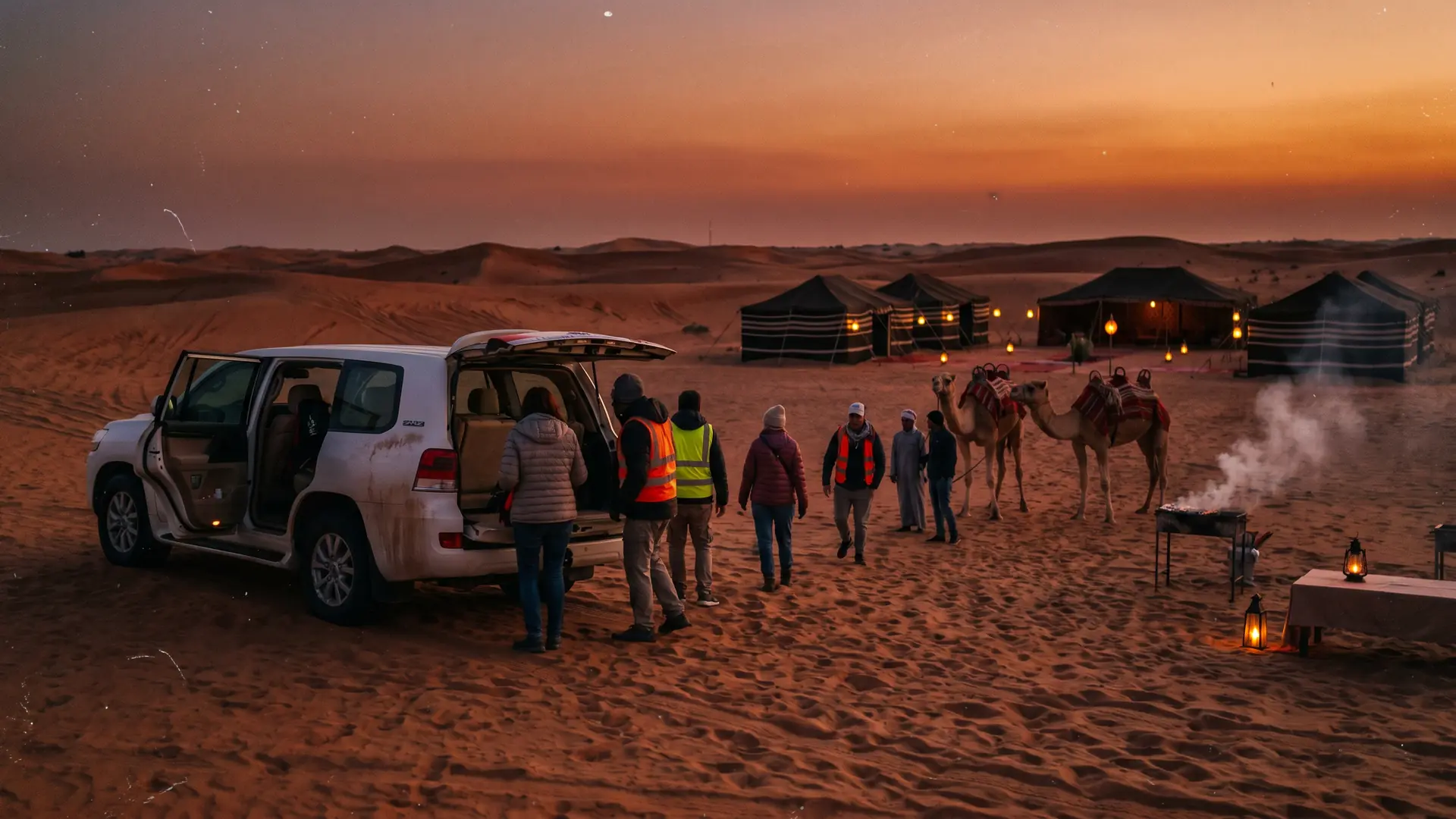
Dune bashing that ends right as the sun drops, followed by dinner at camp, with the vehicle handling both ends of the trip.
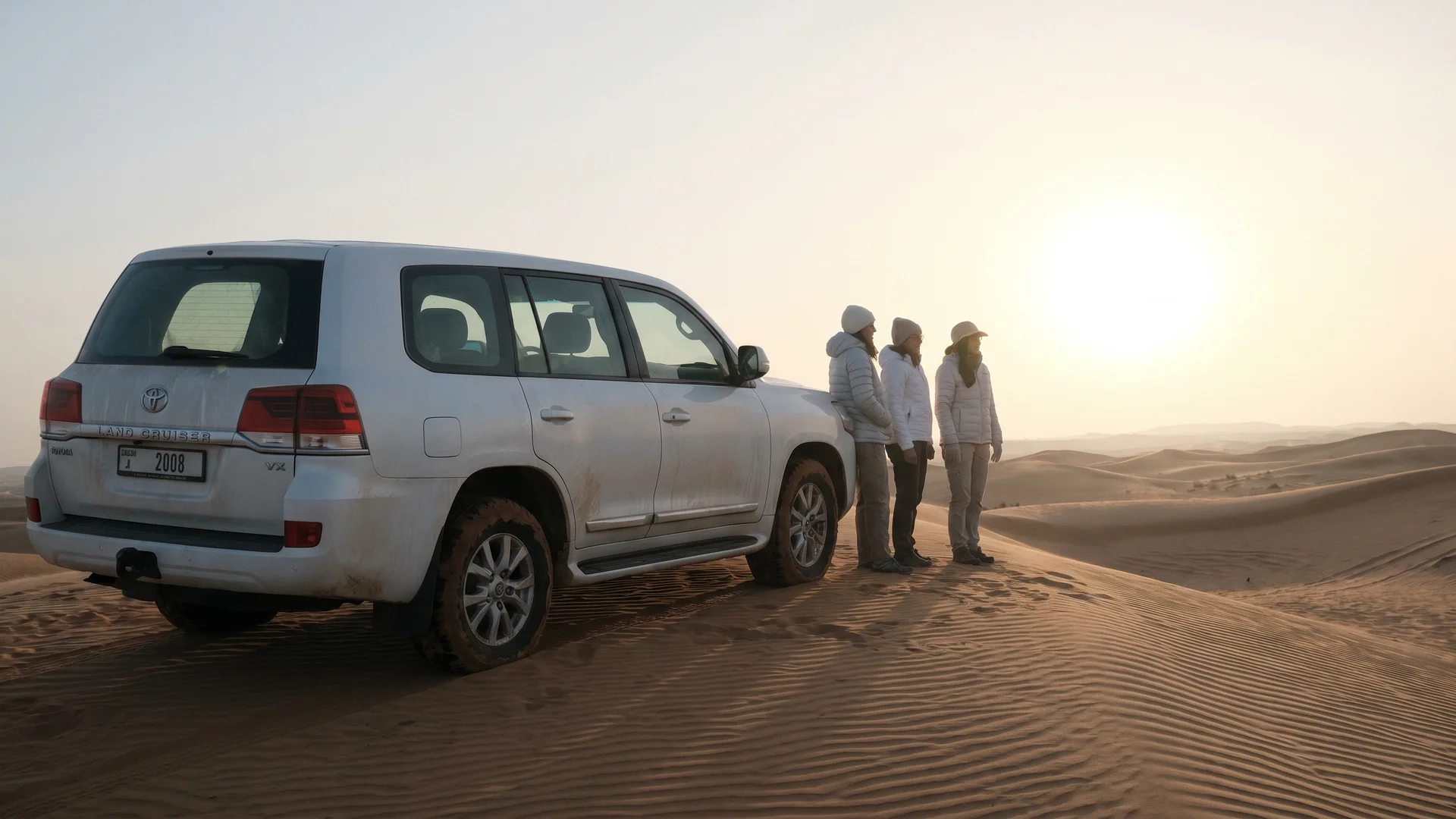
Your vehicle, your guide, your pace. Nobody else's schedule gets a vote.
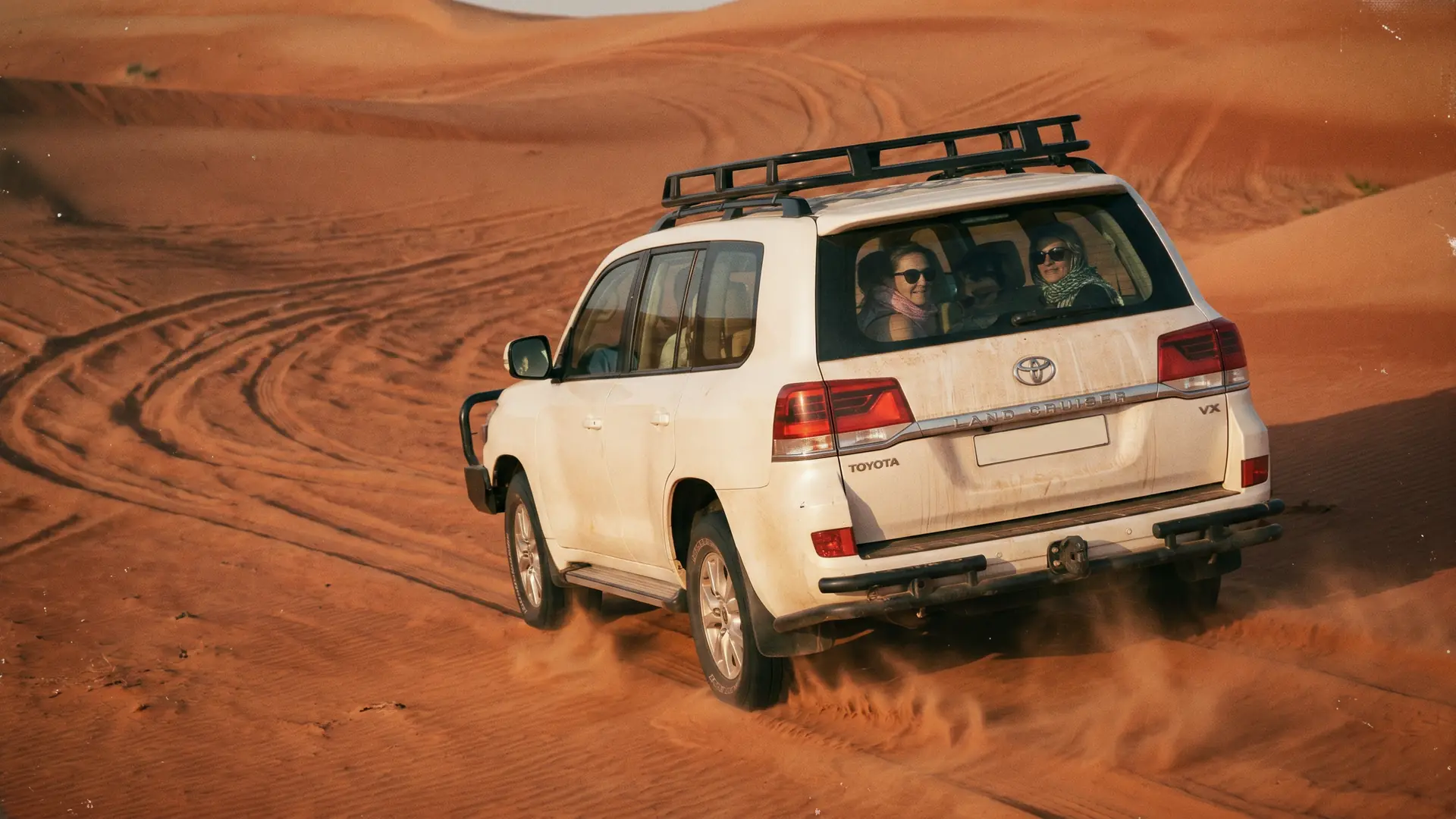
The same evening route, but it's your group alone, right through to dinner at the camp.
Overnight camping, VIP setups, company outings, larger families and a gentler route without any bashing over the dunes can all be put together on request. Tell WhatsApp what your group needs and the itinerary gets shaped from there.
Sunrise flights, weather allowing, flying roughly September through May. Nothing else on this page cancels for wind as easily as a balloon does.
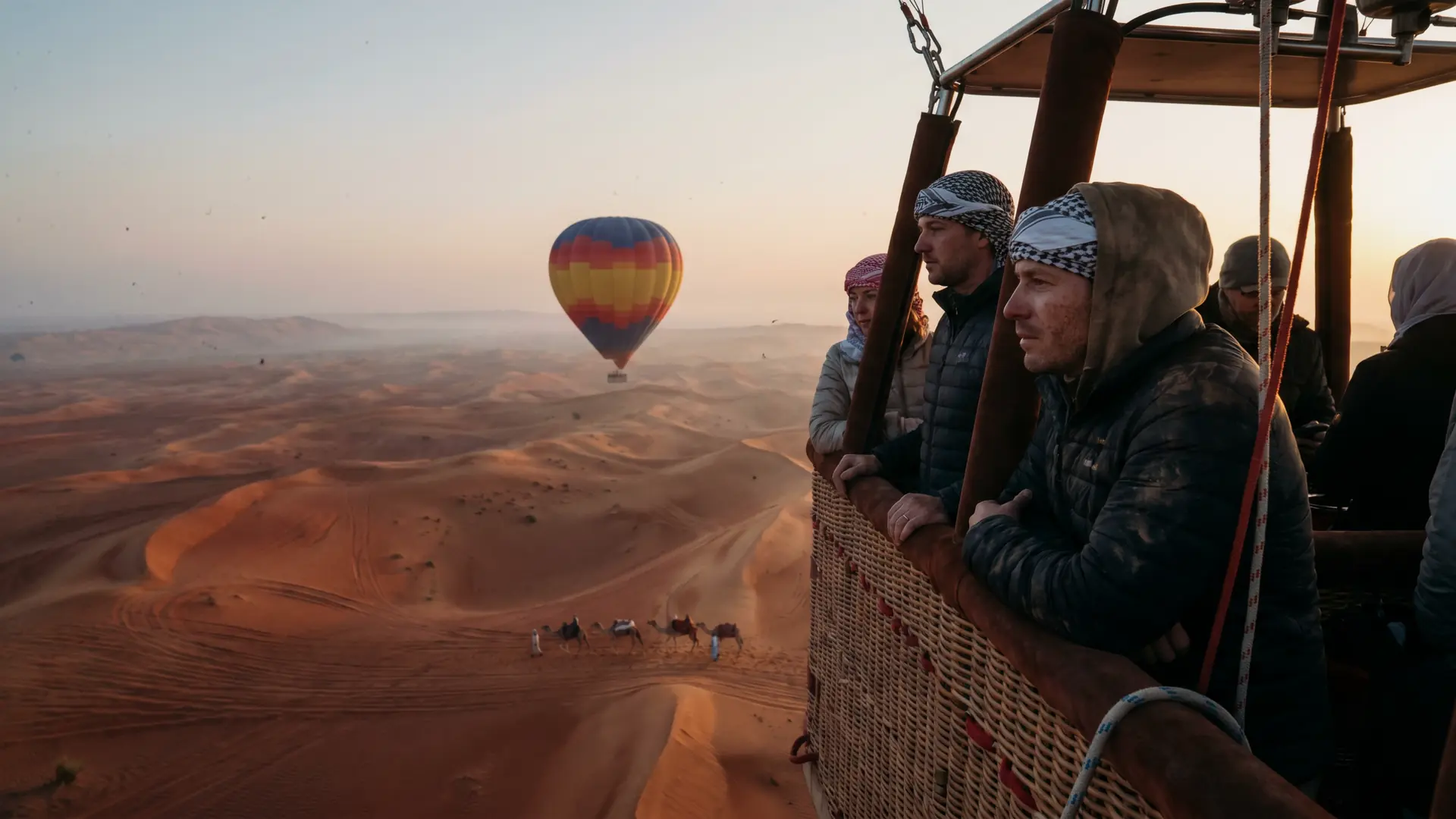
AED 1,049 gets you airborne. AED 1,149 adds a falconry stop, AED 1,349 folds in a full breakfast after landing.
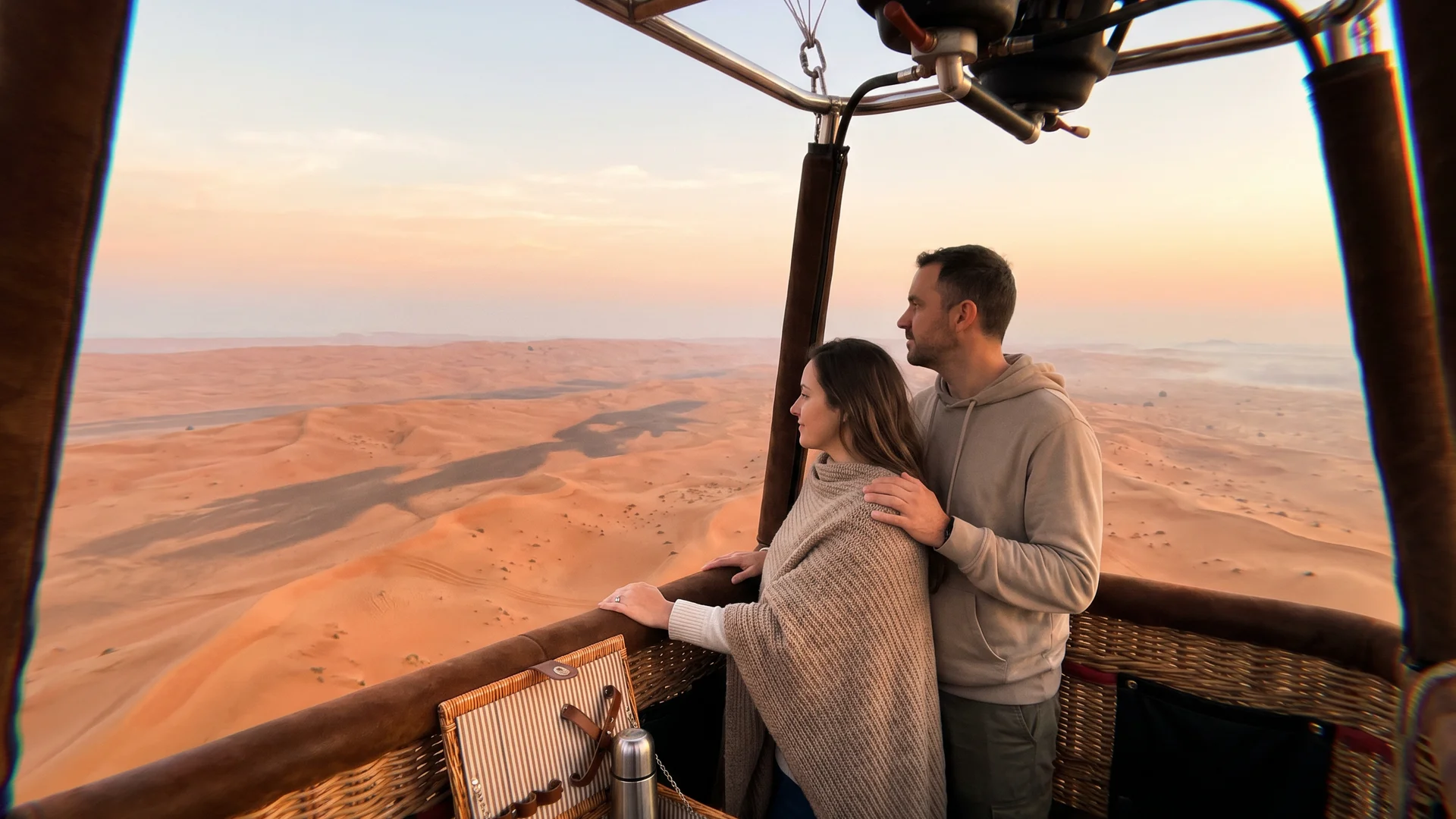
Book out the whole basket. Common for proposals, anniversaries and company outings that want the balloon to themselves.
For grandparents, toddlers, or anyone who took a long look at the Raptor and quietly backed away. Same stretch of dunes, just a gentler pace across them.
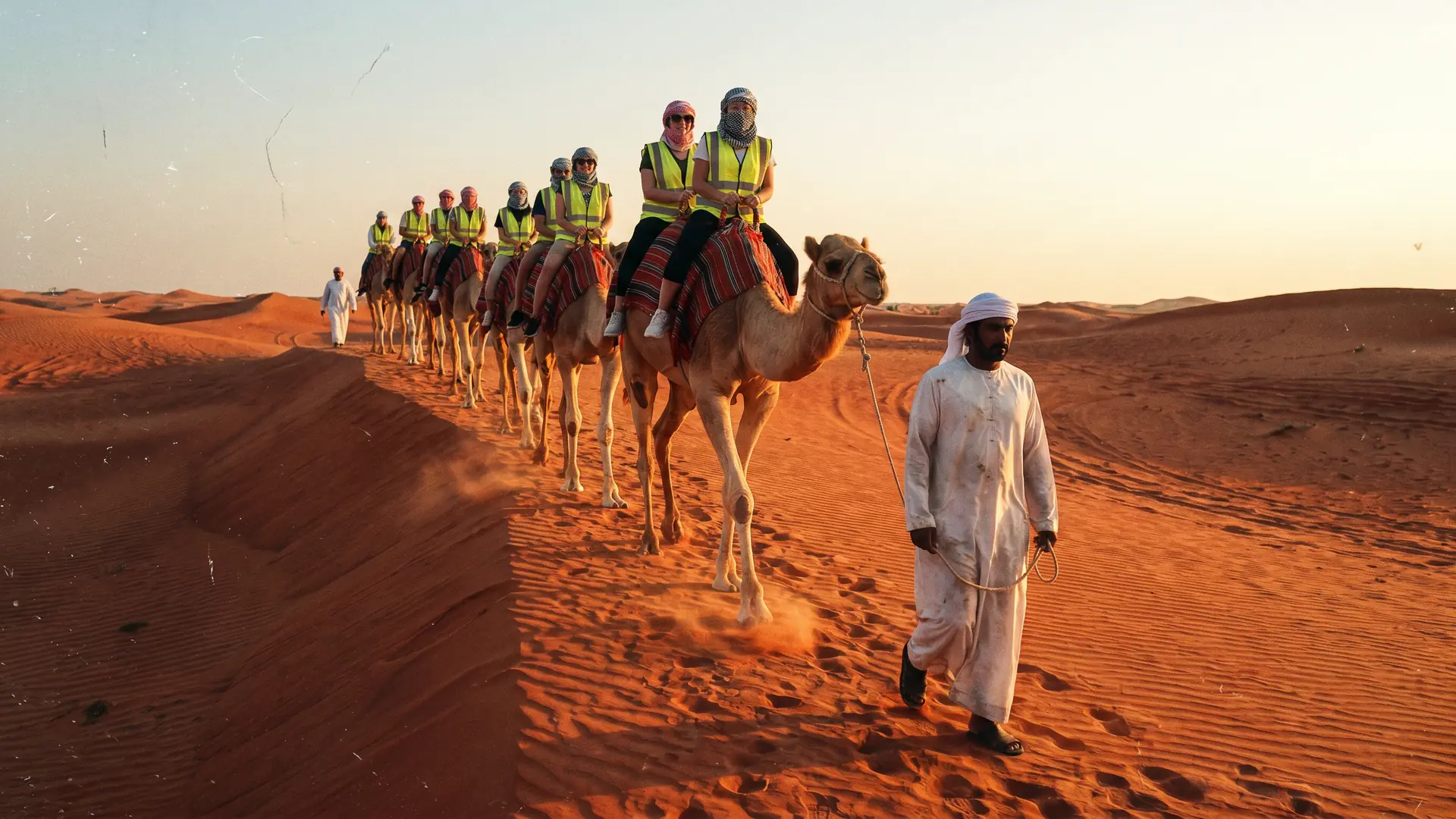
A guided walk across the same sand the quads run on. Open to age three and up, seated with an adult.
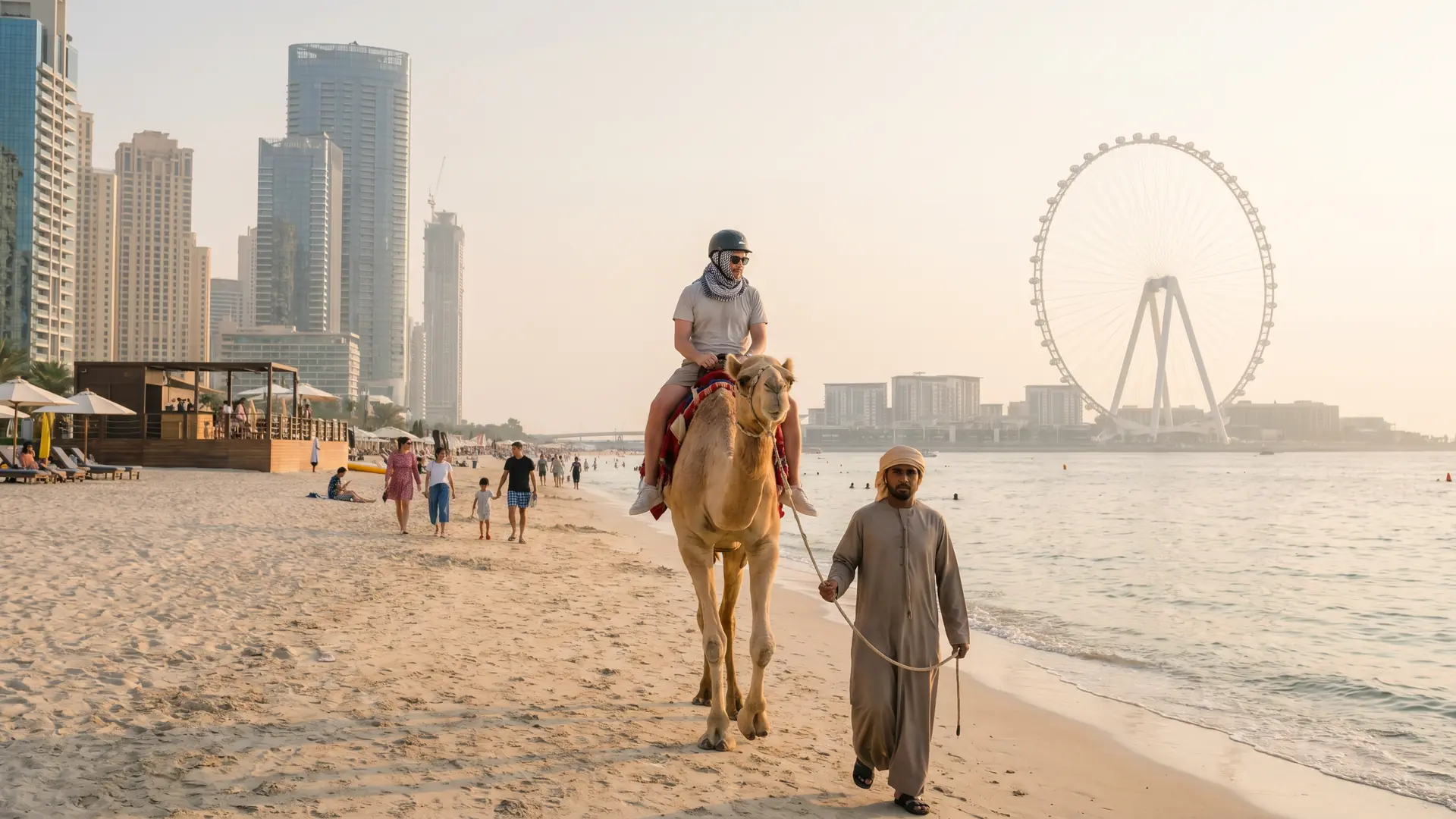
Right in the city, skyline in the background. This is the shot most people actually come home with.
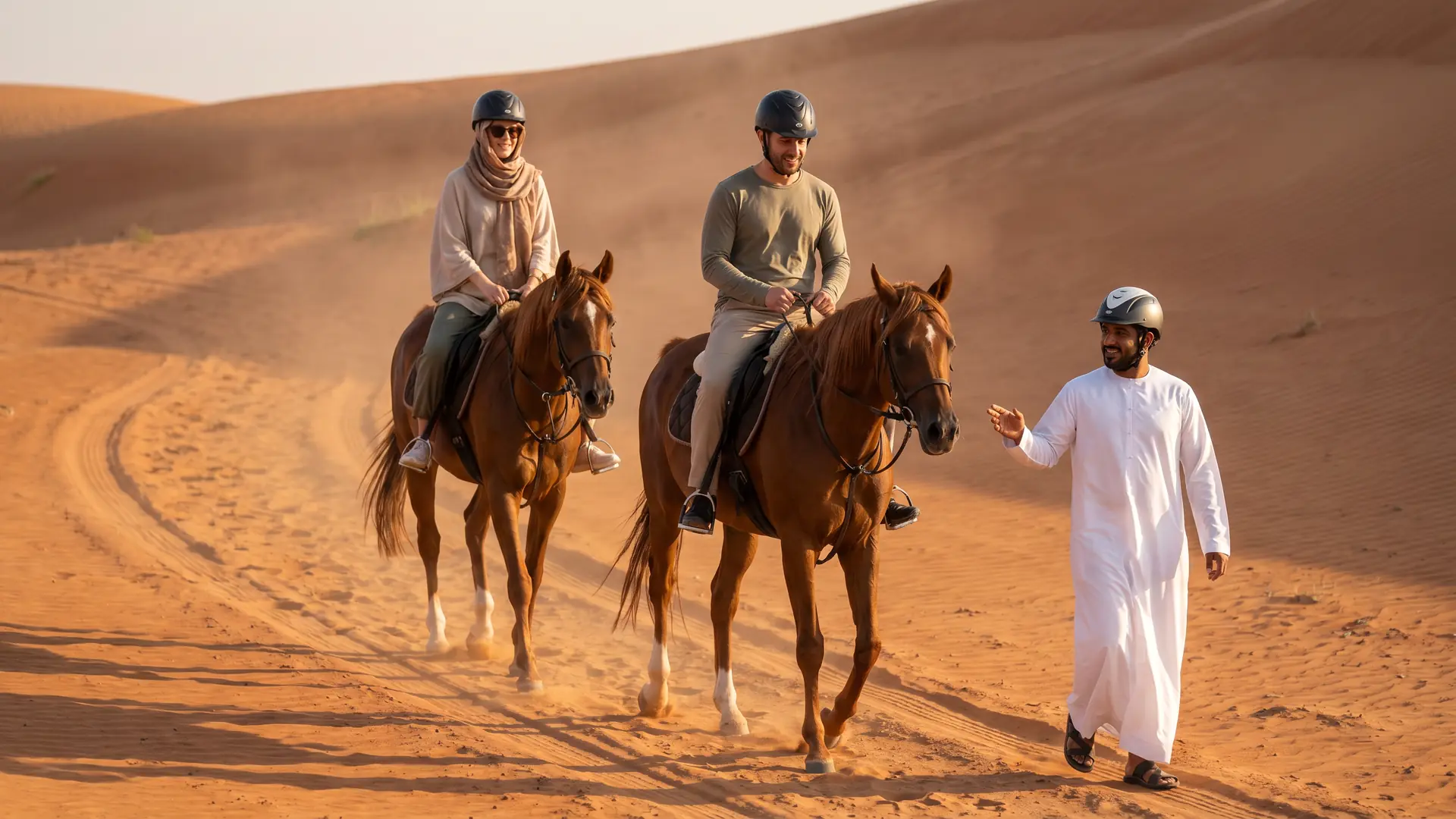
A guide leads the trail out into the desert, best matched to someone who has actually spent hours in a saddle already.
These are quoted rather than listed, since the final number depends on your group size, the machines you choose and how full you want the itinerary. Send the details over WhatsApp and a figure lands back the same day.
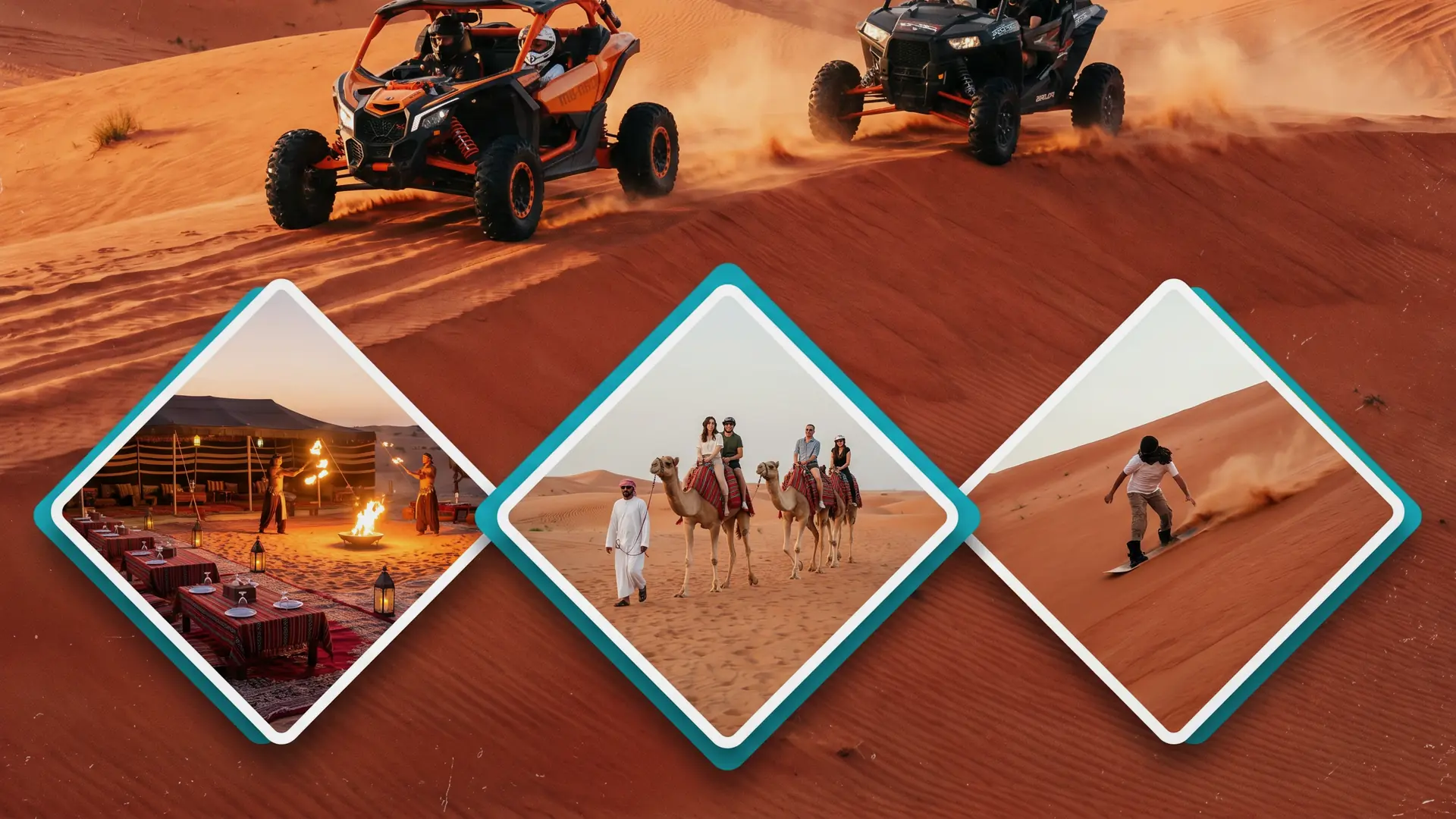
Quad while your arms are fresh, buggy once they're not. Built from a quad session from AED 200 plus a buggy from AED 599, priced on request.
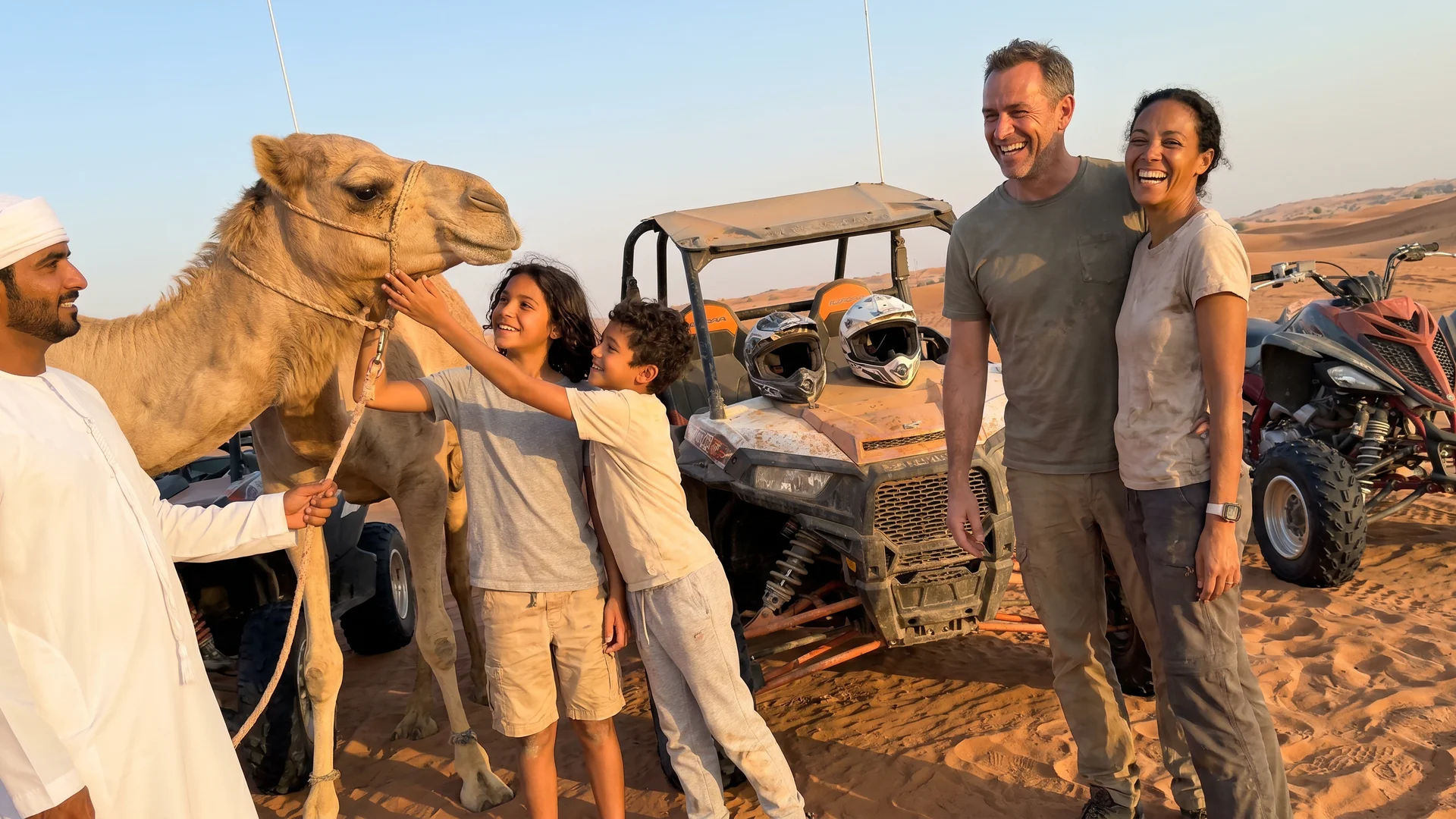
One booking covers a quad, a buggy and a camel, laid out so a nine-year-old and a grandparent each end up doing something that actually fits.
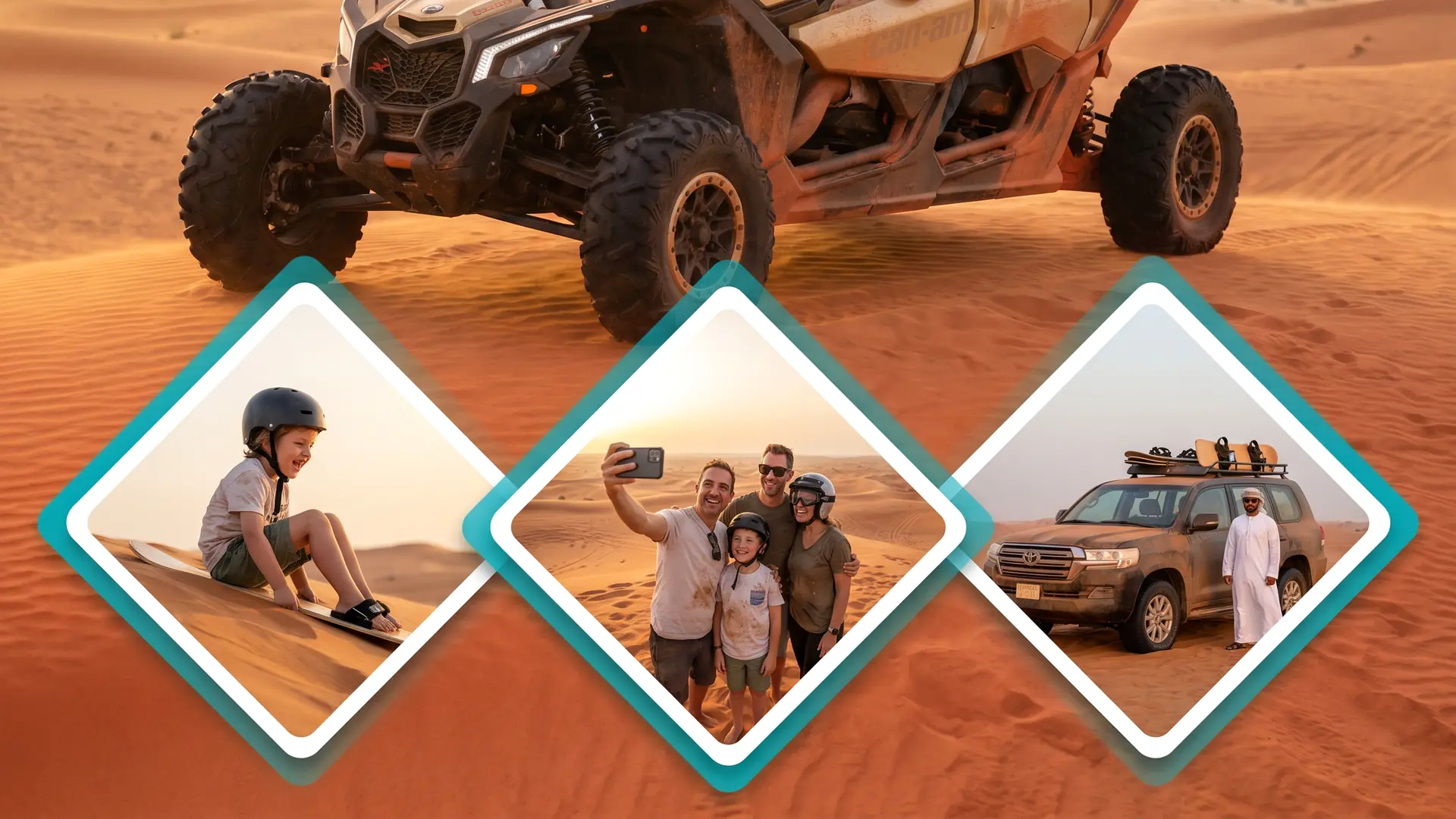
Quad, buggy, safari and the BBQ camp stacked into a single outing. Message your group size and it's priced on request.
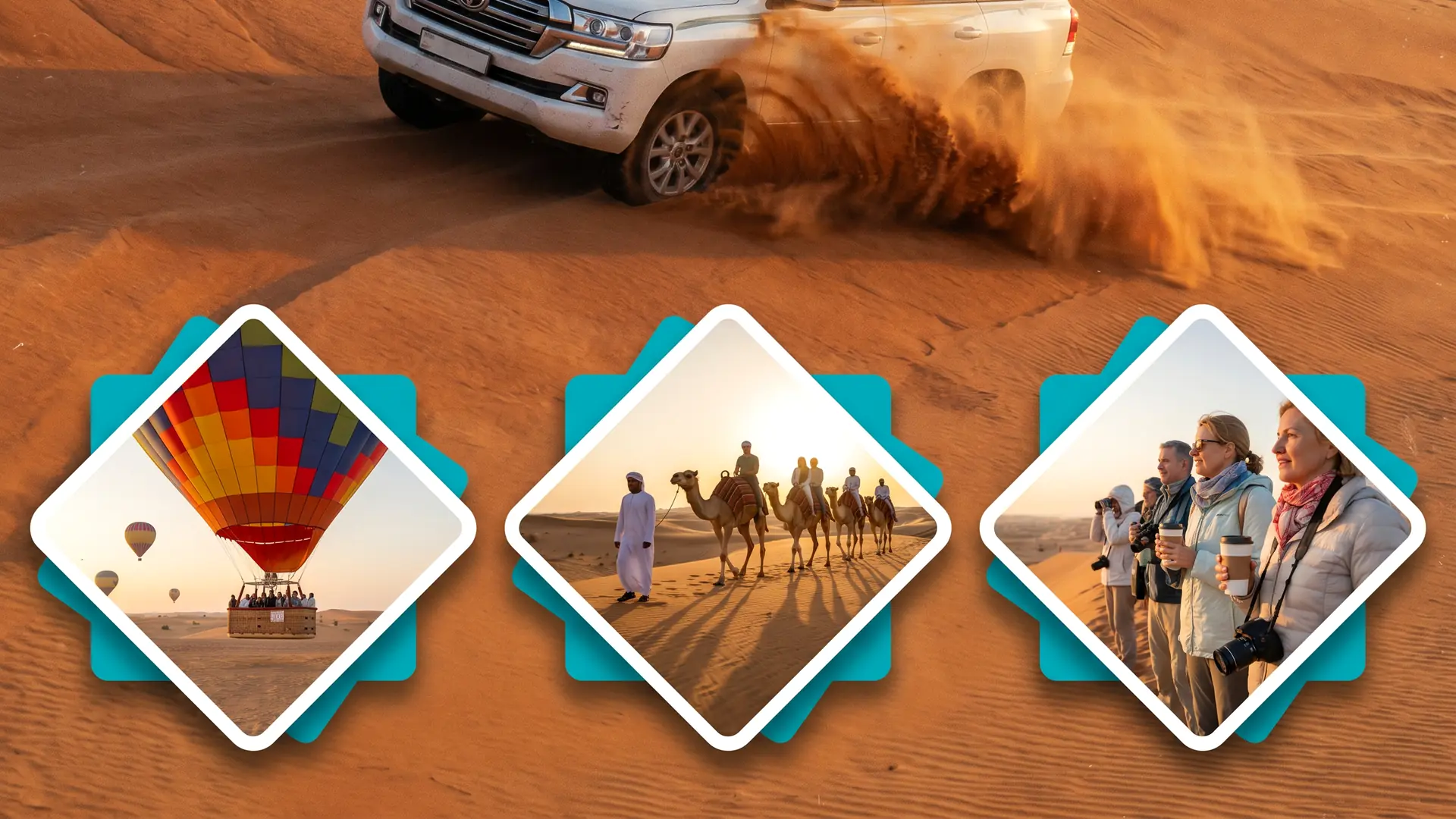
Up before sunrise for the flight, back on the sand once the light has properly arrived. Long day. Worth setting the alarm for.
Quads, buggies and the KTMs all launch from one base at Al Lahbab, well clear of town, out along the route that runs toward Al Ain. It's the iron-red sand that shows up in every photo, shaped into genuine bowls instead of the low mounds you'd see closer to the highway.
Before anyone points you at a slope, there's flat, firm ground at the base to warm up on. That short stretch is where a guide reads how you handle the throttle and sets your route from there, which is most of the safety plan in one move.
Six stages, and they don't change whether you booked the shortest slot going or stitched together a whole evening. It's the middle stage that stretches.
A driver collects you somewhere in central Dubai, or you get directions to the base once the booking is confirmed.
The helmet goes on first, then it's hands physically on the throttle and brakes while a guide walks through body position and the stop signal.
Nothing but flat ground until the guide has watched enough to quietly settle on your route.
You track the lead machine across the bowls and along each ridgeline, pausing where the route allows for photos.
A minute to catch your breath, water, a scroll through the day's photos, then either a lift back or straight on to whatever else you booked.
Dinner packages carry straight on from here into the halal BBQ camp.
The kids' 90cc loop is open between nine and twelve years old, watched over the whole time with a guardian standing by. Below that age, a seat on a camel opens up starting at three, or a spot riding along in a buggy while someone older handles the wheel. Flag anything uncertain about your group when you book, not once everyone's already standing at the briefing. Dream Land Adventure Tourism carries the required DTCM paperwork, and once you're actually out among the dunes, it's the guide's judgment that decides what happens next.
Based on 1,193 Google reviews
Based on 641 reviews
The Yamaha 220cc opens the adult lineup at AED 200, and the Raptor 700cc closes it at AED 795, though the AED 250 400cc is genuinely where most riders end up. A separate, supervised 90cc loop for nine to twelve-year-olds runs AED 150. Each figure buys one seat on one machine, apart from the AED 350 double, built specifically to carry two riders at once.
No licence of any kind is needed. The whole session takes place on privately owned desert land out at Al Lahbab, away from any public roadway, so there is no document anyone checks at the entrance. What guides actually assess is your physical control of the machine, judged during the warm-up before anyone gets sent near a real dune face.
Nine years old is the cutoff, riding only the supervised 90cc loop while a guardian stays within reach the entire time. Below that, a child can still be part of the group as a buggy passenger with an adult behind the wheel, or take a camel out starting at age three.
There is exactly one machine built for it, the Yamaha 400cc double, carrying a genuine two-up seat for AED 350 as a single flat charge. Every other bike in the lineup takes one rider only, so squeezing a second person onto a solo machine is not something to plan for. The base will not allow it.
At Al Lahbab, a stretch of desert reached via the road toward Al Ain, about 45 minutes' drive from Downtown. That is the deep red sand seen in most photos of this area, distinct from the lighter, busier sand right beside the highway.
As standard, no. Pickup gets added and priced separately, confirmed before any payment goes through. Stops around Marina, JBR, Downtown, Business Bay and Deira are all handled routinely. Prefer to drive yourself? Directions arrive once the booking is locked in.
A quad suits you if having a machine nobody else touches matters, and leaning your body weight into a turn does not bother you. A buggy suits you better if a steering wheel, a harness and a roll cage feel safer, especially once passengers are involved. Quite a few groups book both anyway and switch over partway through the visit.
Closed-toe shoes, sunglasses, and something you will not mind covered in sand by the end. A helmet comes with every booking regardless. Covering your nose and mouth with a buff or scarf does more good than most riders anticipate, and packing a spare outfit for afterward is a smart move.
Someone doubles back to free you, and the whole thing is treated as an ordinary part of riding rather than something gone wrong. Nine times out of ten it traces back to backing off the throttle halfway up a soft dune face. Getting moving again takes a couple of minutes, at no extra cost.
It is, provided you book the 220cc and mention your lack of experience upfront at the briefing. A warm-up stretch on flat sand comes first, giving the guide a chance to see how you handle things before your route gets decided. Anyone who needs a softer line quietly gets one, no fuss made about it.
The base fee buys a single loop of the dune circuit. Anything longer, or a day mixing several activities, gets arranged individually per group, and once a safari or dinner joins the booking, it can easily fill most of an evening. Tell the team your plans and precise timing gets sent back to you.
Both can be added, and it is the route most bookings actually take. Top of the list by volume is the evening version at AED 375, pairing a quad with the safari and BBQ. Swap it for the morning slot with a quad and the figure drops to AED 290. Skipping the dune-bashing altogether but keeping the quad and dinner lands somewhere between AED 700 and AED 1,300, depending on which machine you are on.
A sandstorm or heavy wind pushes a session to a new date rather than cancelling it outright, with a message sent ahead of time offering fresh slots at no added cost. Nothing here is as weather-dependent as the balloon flights, which are affected far more easily than anything with wheels.
For a weekday, a couple of days' notice is typically fine. Fridays and Saturdays need closer to a week, and longer again if the Raptor 700cc specifically is what you are after, or a set of matching machines for a group. What actually reserves the slot is completing secure payment online ahead of time.
At its core, quad biking Dubai is climbing onto a Yamaha of your own at the Al Lahbab base, roughly 45 minutes southeast of Downtown, and controlling it yourself with a lead guide showing the way rather than doing the driving for you. The 220cc opens the adult range at AED 200, the Raptor 700cc tops it at AED 795, and the AED 250 400cc sits in between as the machine carrying most of the bookings, alongside a supervised AED 150 loop built for kids on the 90cc. Beyond the quads, the same operator puts you in a buggy for AED 599 and up, hands over a KTM dirt bike starting at AED 850, runs Land Cruiser safaris from AED 225, sends a balloon up at sunrise for AED 1,049 and has camel rides on offer at AED 150.
Of every package this business sells, the Evening Desert Safari with Quad Bike and BBQ at AED 375 gets booked the most, since it packs dune bashing, a quad session under your own control and camp dinner into one evening out. Secure online advance payment confirms your booking, support available 24/7.
Dune bashing rolls into a solo ATV run, then straight into camp dinner.
AED 375The forgiving first quad. Light enough to correct mid-turn without drama.
AED 200Enough torque to climb a soft face before your technique is fully there.
AED 250Two-up seating on one bike, billed once rather than per rider.
AED 350The fastest machine on the fleet, screened before the keys change hands.
AED 795Ages nine to twelve, its own supervised loop, guardian on site throughout.
AED 150Airborne over the same dunes just as the light starts to come up.
AED 1,049Your own vehicle, route and camp table, no other group folded in.
AED 1,400Rougher and more physical than the photos suggest. You feel the engine through your legs, every dip in the sand travels straight up into your wrists, and by the end of an hour your forearms know exactly what they did.
The first thing that surprises most riders is how much the machine talks back to them. A quad doesn't insulate you from the ground the way a car does. Every rut, every patch of firmer sand hiding under the soft top layer, comes straight up through the handlebars. On the flat warm-up stretch near the start of a session that's a minor buzz. On a proper dune run it's constant, and it adds up faster than most first-timers expect.
Climbing changes the feel completely. You shift forward, weight over the front wheels, and the engine note drops into a lower, grittier pitch as the tires search for grip in loose sand. There's a specific moment right at the top of a face where the machine goes light under you for half a second, right before the ground drops away on the other side. Riders who've done it more than once start chasing that moment on purpose.
Coming back down uses a different set of muscles entirely. You sit back, let the machine run a little rather than crawling it, and brake in short taps instead of one long squeeze, because grabbing a fistful on loose sand just locks the rear end and sends you sideways. The line the guide picks down a face is rarely the steepest way down. It's usually the one with the fewest surprises hidden in it.
Heat and grit are the two things nobody mentions beforehand. Even in the cooler months, an hour of physical riding under a helmet works up a real sweat, and sand finds its way into your collar, your visor and your shoes no matter how careful you are. None of it is unpleasant exactly. It's just what an hour on a quad actually costs you physically, and it's why guides hand out cold water the second you're back at the base.
The size of machine you're on changes the intensity of all of this rather than the nature of it. A 220cc hums along and lets you focus on the terrain, while the Raptor 700cc puts a noticeably harder edge into every one of those same sensations, the vibration sharper, the feedback through the seat quicker to arrive. Neither is more real than the other. They're different volumes of the same underlying feeling, which is a large part of why the fleet spans all the way from a gentle 90cc to a machine that experienced riders specifically ask for by name.
Watch the shading, not the color of the sand itself. A visible shadow across a face usually flags a change in slope, and the softer sand tends to sit duller and darker in the low bowls between ridges rather than on the wind-packed crests.
The sand gives away more than most riders expect once they know what to look for. Wind-packed crests hold weight better than the soft, shaded bowls between dunes, and the difference often shows up in color alone, packed sand reading a shade lighter than loose sand sitting in shadow. Guides read this constantly during a session, which is part of why the lead machine's line rarely looks like the shortest way across.
Climbing a face comes down to approach angle and commitment more than raw power. Come at a dune too square-on and the front end can push sideways instead of climbing; angle in slightly and hold steady throttle rather than stabbing at it, and the machine tends to find its own grip. The classic beginner mistake is easing off right at the moment more power is actually needed, which is exactly when a machine bogs down and stalls the climb.
Descents ask for the opposite instinct. Weight goes back, speed stays controlled rather than crawling to a stop, and your eyes go to where the slope levels out at the bottom rather than at the sand directly under the front wheels. Staring too close in front is how riders end up fixating on a rut and steering straight into the one thing they were trying to avoid.
None of this gets dumped on you all at once. The flat warm-up stretch is where a guide watches how your hands and eyes actually work before deciding which quad and which route suit you, and corrections happen quietly mid-ride rather than as a lecture beforehand.
Existing tracks in the sand are worth reading too, not just the raw terrain. A well-used line across a dune face usually means other machines have found grip there before, and following roughly the same route rather than cutting a fresh line through untouched sand tends to be the easier, more predictable ride. Guides default to established lines for exactly this reason, and only break off them when a stretch has clearly softened or shifted since the last group came through it.
Not one-handed, no. The realistic setup is a chest or handlebar mount for video, plus the photo stops built into every route, and guide-shot photos from the session that get sent to you afterward at no charge.
Riding one-handed to hold a phone up is a bad idea on a quad, and not because anyone will stop you doing it. Sand swallows a dropped phone fast, and digging one out of soft sand while the rest of the group waits is a genuinely common way to lose ten minutes of a session that only runs an hour to begin with.
A chest mount or handlebar mount solves most of it. Both keep your hands free for the actual riding and still capture the bumps, the dust trailing behind you, and the moment a machine catches a little air off a small crest. Bring your own if you have one. The base can point you toward where a mount clips on but doesn't stock cameras to rent.
Every route has built-in stops, usually at a ridge or a flat clearing, where engines go quiet and everyone gets a minute for an actual photo instead of a blurry one grabbed at speed. Guides also shoot photos through the session on their own gear and send them on afterward at no charge, which tends to be where the best group shots come from anyway.
Timing matters as much as equipment. Late afternoon, roughly an hour before sunset, is when the red sand actually reads red in a photo instead of washed out and pale, which is a large part of why the late-day slots are usually the first to fill.
Handing a phone to the guide for a specific shot at a stop works fine too, and plenty of riders do exactly that rather than bothering with a mount at all. It's not something to lean on for continuous footage, though, since the guide is watching the group and not operating a camera. If video of the whole session actually matters to you, mention it before you start so a stop or two can be planned around it instead of improvised on the move.
A session's group is whoever booked that slot, riding behind one lead guide who sets the pace for the whole line. Pace gets built around the rider having the hardest time, not the one showing off at the back.
A group might be your own family of four, or your four riders sharing a slot with another couple who booked separately. Larger private groups and corporate outings get their own dedicated timing rather than being folded into a shared session, which is worth mentioning when you book if your group is more than a handful of people.
One guide rides point and controls the entire line's speed, and spacing between machines is kept deliberately wide enough that nobody's eating the dust cloud off the bike ahead of them. That spacing is also part of the safety setup rather than just a comfort choice, since it gives everyone room to react to soft sand without a machine sitting right on their tail.
Mixed ability is the normal case, not the exception, and it gets handled through the route rather than by splitting the group in two. Everyone rides the same loop, but a guide reads who needs an easier line through a given stretch and simply steers the whole group that way, without making an announcement about who it's for.
Communication out there is almost entirely hand signals, since engine noise kills conversation past a couple of meters. A raised hand means stop, and guides glance back often enough that a rider who's fallen behind or is struggling gets noticed within seconds rather than at the end of the loop.
Solo travellers get folded into whichever group is already running that slot rather than needing a minimum headcount to book at all, which surprises people who assume a private guide is required to ride alone. It also means the exact makeup of your session, families, couples, a group of friends, isn't something you can predict ahead of time, though the guide sets pace and route the same careful way regardless of who actually turns up on the machines that day.
One session is enough to genuinely enjoy the dunes and leave competent on moderate terrain. Real comfort on steep faces and technical lines takes repeat visits, the same way any physical skill does.
Most first-timers leave a single session riding confidently on moderate terrain, which is honestly the whole goal for the vast majority of people booking a one-off desert day. You won't be chasing the guide up the steepest faces by the end of an hour, and nobody expects that from a first visit.
What a second visit changes is how much you're thinking versus feeling. First-timers consciously process throttle, brakes and body position as three separate steps happening in sequence. Riders back for a second or third go report the machine starting to feel like an extension of their own weight rather than a set of controls to manage, and that shift is usually what pushes people toward a bigger machine or the turbo upgrade.
Returning riders tend to self-select toward the machines built for more: the Grizzly 450cc for longer, rougher routes, or the 625cc sports quad and Raptor 700cc for anyone who wants a bike that demands proper technique rather than forgiving a sloppy one.
None of this makes a single visit a lesser experience. It just means quad biking behaves like any physical skill, better with repetition, while still being a complete, satisfying afternoon on its own rather than a taste of something you're obligated to come back and finish.
For visitors who return to Dubai on a semi-regular basis, that progression compounds in a way one holiday alone doesn't capture. Riders who've done three or four sessions across separate trips describe the warm-up stretch feeling almost redundant for them personally, though guides run it every single time regardless of stated history, since a machine or a dune face can behave differently from one session to the next even for someone who's ridden that exact route before.
Light wind barely registers once you're moving. Strong wind kicks loose sand into a haze that cuts visibility and grit into everything, and that's the point at which a session gets rescheduled rather than run as planned.
Some dust is simply part of riding in a group, since the machine ahead of you throws sand into the air and the spacing between riders exists partly to keep you out of the thickest of it. A buff or scarf over your nose and mouth handles this easily, and it's the single most useful thing riders bring that the base doesn't already hand out.
Actual wind is a different situation from ordinary riding dust. When wind picks up enough to lift loose sand off the crests on its own, visibility drops and grit works into everything, goggles included, in a way that's more than a minor annoyance. That's a weather condition rather than a riding condition, and it changes the plan instead of just the comfort level.
On days like that, sessions get moved rather than pushed through anyway, and riders are contacted ahead of their slot with a new time instead of finding out after arriving at the base. It's a judgment call the guides make rather than a fixed cutoff number, since a light breeze on open flat ground behaves nothing like the same wind funneling through a bowl between dunes.
If timing matters to you, morning sessions in the cooler months generally see calmer air than late-afternoon ones, though the gap is minor for most of the year. Riding position inside the group makes a bigger difference day to day. Sitting slightly off to the side of the machine ahead, rather than directly behind it, keeps you clear of its dust without needing the wind itself to cooperate.
Dust doesn't end when the engine does, either. Expect it in your ears, your hairline and the seams of your clothes well after you're back at the base, which is normal and not a sign anything went wrong during the ride. Facilities at the base handle the basic clean-up, but a proper shower waits until you're back at the hotel, so it's worth planning the rest of the day around that if something formal is on the schedule afterward.
Mostly, yes, and the sand is the reason. Al Lahbab's fine, deep red dune sand rides softer and steeper than the packed dirt trails common in places like Morocco or the American Southwest, which changes technique more than it changes the machine.
Riders who've quaded on packed dirt trails in Morocco, rocky tracks in Spain, or mixed terrain across the American Southwest usually notice the sand first. Al Lahbab is fine, deep, wind-shaped dune sand rather than a hard-packed trail, and it behaves completely differently under a tire. Trail riding rewards speed and momentum. Deep dune sand punishes momentum when your line is wrong, and rewards a steadier, more deliberate throttle hand instead.
Climate shapes the schedule here in a way it doesn't everywhere. Sessions run around the cooler parts of the day for most of the year, morning or late afternoon, rather than the flexible all-day riding common in milder climates. Anyone used to booking a midday slot elsewhere should expect Dubai's timing to look different, and it's worth checking where and when sessions run before locking in a date.
Structure sets it apart too. This isn't a sign-a-waiver-and-go rental where you're handed a machine and left to find your own way. A guide stays out front for the whole session, dictating both route and speed, which tends to be tighter supervision than riders describe from trail parks in other countries, and the whole arrangement sits on private land with no licence requirement rather than a permitted public trail network.
Experience from elsewhere genuinely helps. It shows up fast in how quickly someone reads the sand and settles into a rhythm. What it doesn't do is skip the warm-up, because deep dune sand is different enough from packed trail riding that even confident riders still get a few minutes on flat ground before a guide sends them at anything steep.
Cost structures also look different to visitors comparing against quad experiences elsewhere. Where some destinations charge by the hour with equipment rental as a separate line item, sessions here bundle the machine, fuel, guide and safety gear into one price per rider, which makes comparing a Dubai quote against a price seen somewhere else less straightforward than it first appears. It's worth confirming exactly what any quoted price includes wherever you're comparing it against, rather than assuming the numbers are describing the same thing.
You're never out there solo. A lead guide rides at the front of every group and sets the route, and other riders in your session are on the same loop at the same time. If you fall behind or stop, the guide notices within moments rather than at the end of the loop.
It helps more than people expect. Balance, leaning into a turn and reading the ground ahead all carry over from cycling, even though a quad's throttle and brakes work completely differently. Book the 220cc, mention the bicycle experience at the briefing, and the guide will set your route around it.
There's no single published figure, since it depends on the specific machine as much as the number itself. If it's a concern, raise it on WhatsApp before booking so it gets confirmed ahead of time rather than becoming a surprise at the base.
Helmets are provided for every rider. Gloves aren't standard issue, so bring a pair if you already have ones you like riding in. Plenty of first-timers skip gloves entirely and are fine, though they do help on longer sessions if your hands blister easily.
Not mid-session, since a swap means a different machine getting prepped and inspected from scratch. What's easy instead is booking a different machine on a return visit, once you've felt what you actually want more or less of.
Same frame, same handling, so your hands already know the turbo if you've ridden the standard 400cc. The gap shows up specifically when you open the throttle on a straight run or partway up a climb, where the turbo simply pulls harder for the same input.
Yes. The base has facilities for leaving belongings, cleaning up and getting out of direct sun between the briefing and the ride. Chilled water is handed out before you start and again once you're back.
You get the written terms upfront, before paying, rather than something that only surfaces afterward in a confirmation email, and rescheduling for weather never costs extra. Give it a quick read ahead of booking if your travel window is tight.
Longer bookings build in a stop partway through, usually somewhere with a view worth pausing for, mainly for water and a breather. Shorter standard sessions don't need one and typically run straight through.
If the booked machine feels too gentle once you're there, say so at the briefing rather than partway through the ride. Whether an upgrade is possible on the spot depends on what's free that session, so it isn't guaranteed, but guides would rather hear it early than have someone under-challenged for a full hour.
Pick the machine, secure it with payment online, and expect a WhatsApp message the night before confirming exactly when you'll be picked up.